Fore/aft drift
Travel along the berth that keeps going instead of swinging back. This is the one that alarms.
WARN / ALARMDriftScout measures how far a moored tanker travels along the berth, and how far she rises as cargo comes off. Ten readings a second, to better than 10 mm. One sensor on the jetty. One coded panel on the hull.
Nothing is drilled, welded or bonded to the vessel, and nobody goes aboard. Navitrak lidar measures standoff to the fenders. See how it measures.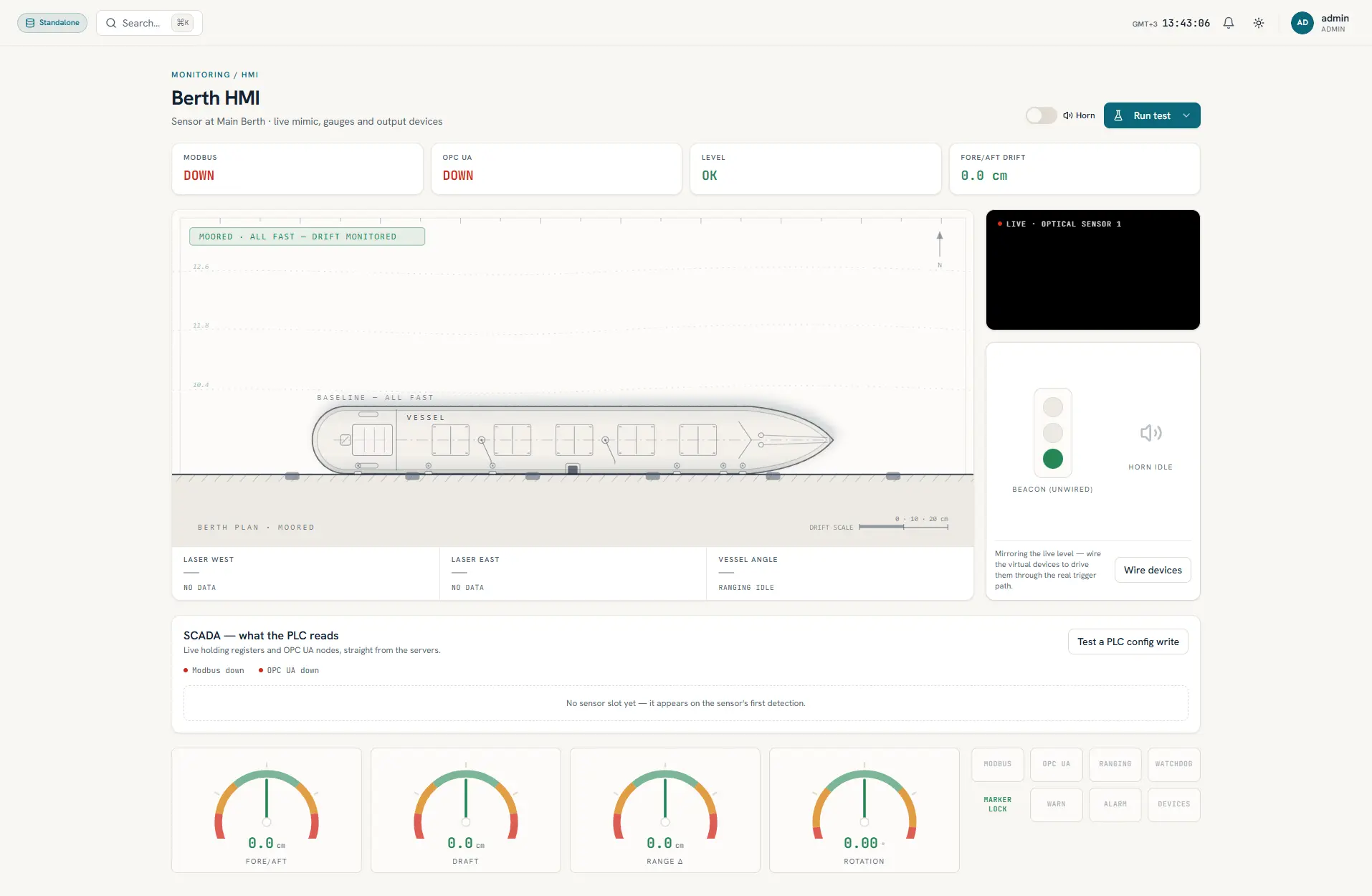
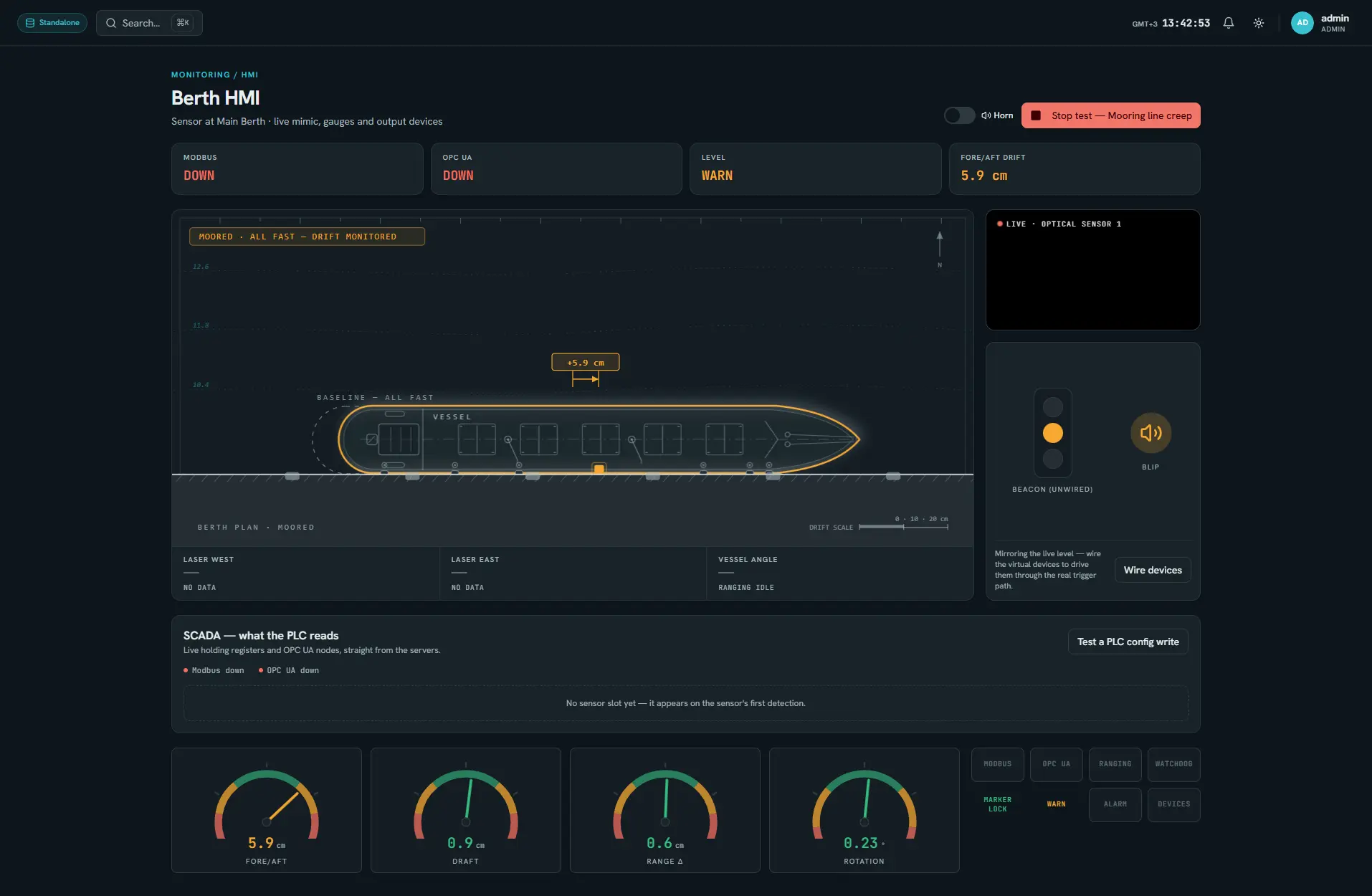
Lines stretch. The tide works her up and down. A passing vessel sets up a surge along the berth. All of it works the moorings and the marine loading arm during cargo transfer, and nobody on the jetty can say how far she has moved until the arm alarms or a line goes. DriftScout puts a number on it while there is still time to tend the lines.
Travel along the berth that keeps going instead of swinging back. This is the one that alarms.
WARN / ALARMShe rises evenly as cargo comes off, and moves with the tide. Expected, so it is reported and never alarms.
ReportedFore and aft draft changing by unequal amounts. She is trimming, not rising evenly, so this one alarms on its own thresholds.
WARN / ALARMHow far off the fenders she sits. Navitrak lidar measures the distance from berth to hull.
ReportedA fixed optical sensor on the jetty watches a coded panel on the hull and reads its movement. Calibration happens once, at commissioning. You only repeat it if something about the site changes.
The sensor finds the coded panel and holds the lock. Until it has one, the console shows no number rather than a wrong one.
Panel movement resolves into travel along the berth, change in draft, and rotation. Navitrak lidar adds the standoff to the fenders.
Wave action is not drift. DriftScout separates the two, then checks travel and rotation against the limits set for that class of vessel.
WARN and ALARM reach every console, the beacon and horn, and the PLC. Each one is recorded and has to be acknowledged.
On once she is all fast, off before she unmoors. Nothing is drilled, welded or bonded, and nothing stays on the hull after she sails.
The same application on the control-room wall display and on a phone at the gangway. It also accepts hand-gesture commands, for when you are on the jetty in gloves.
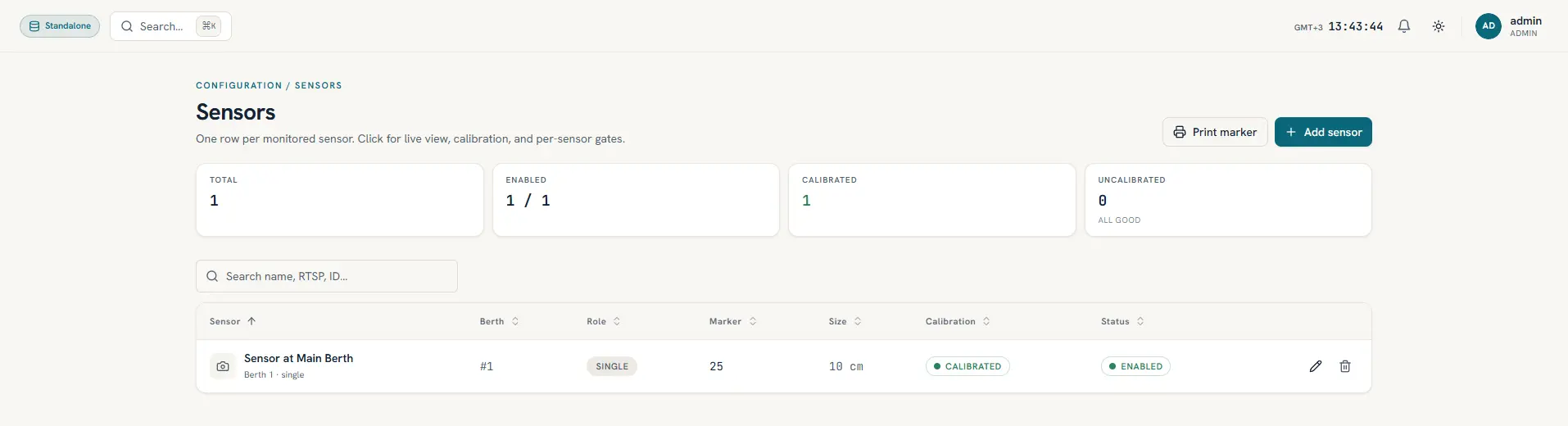
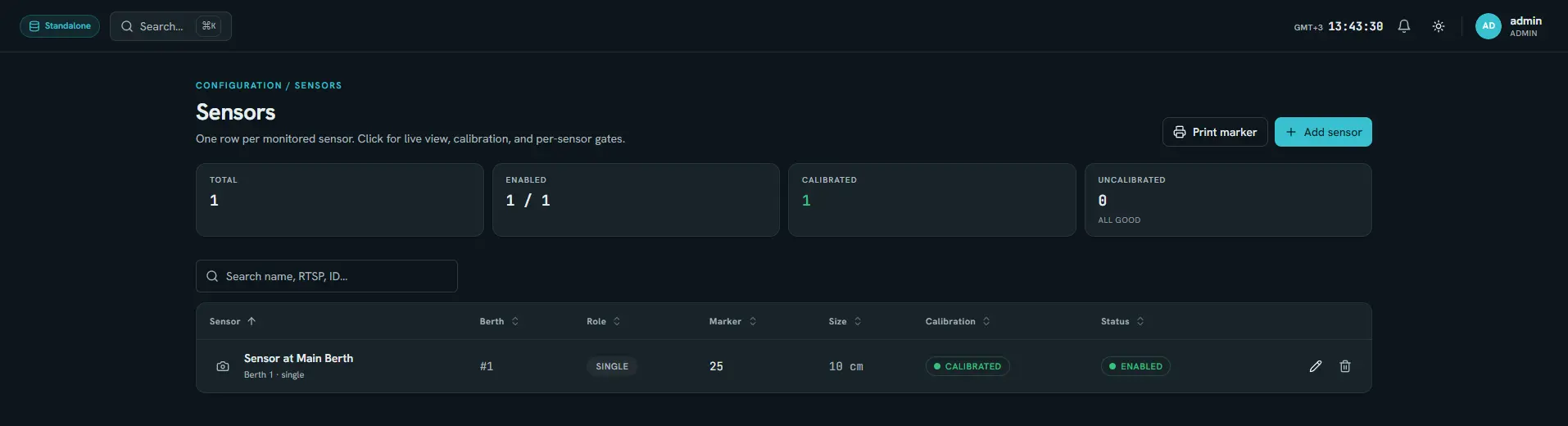
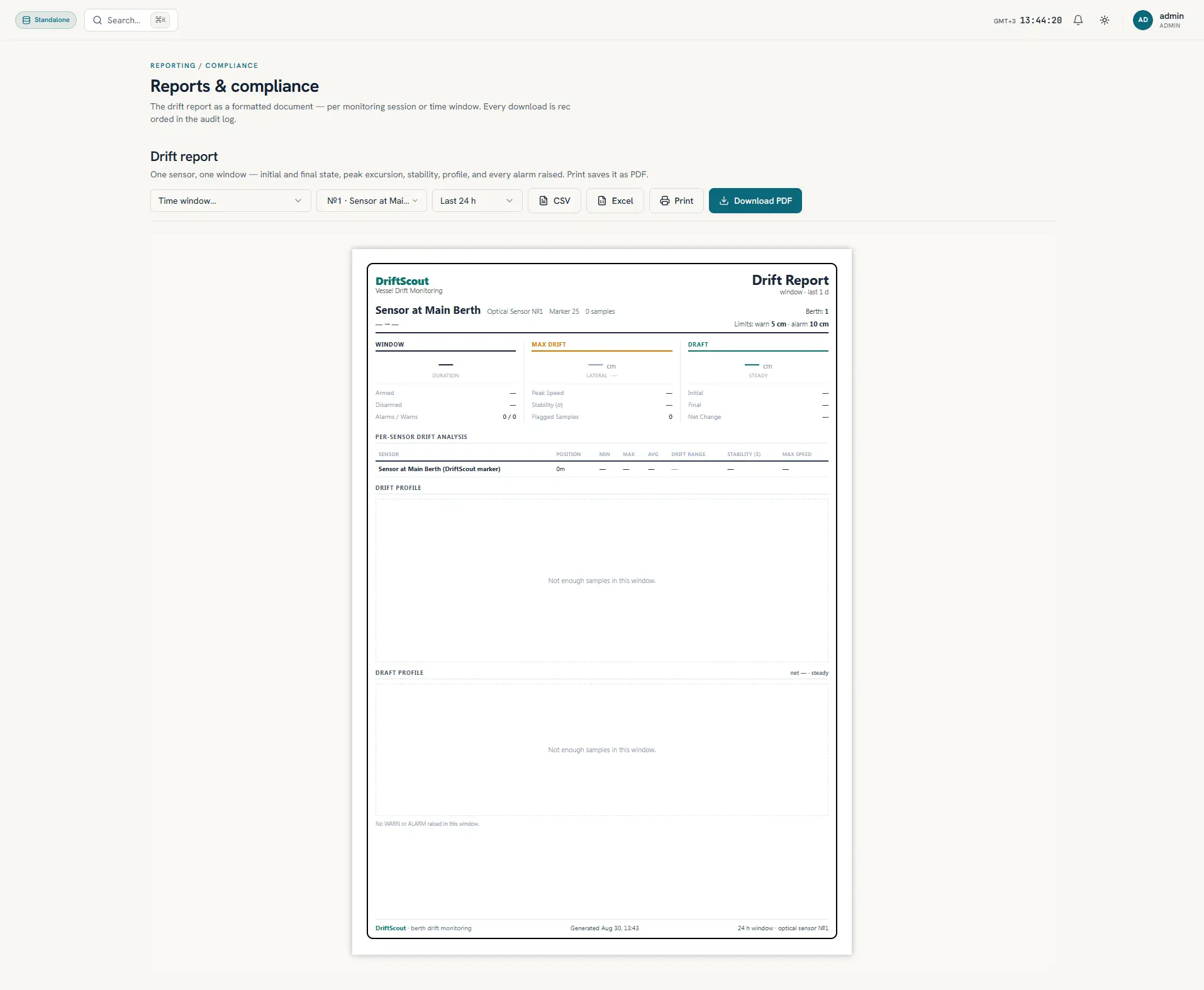
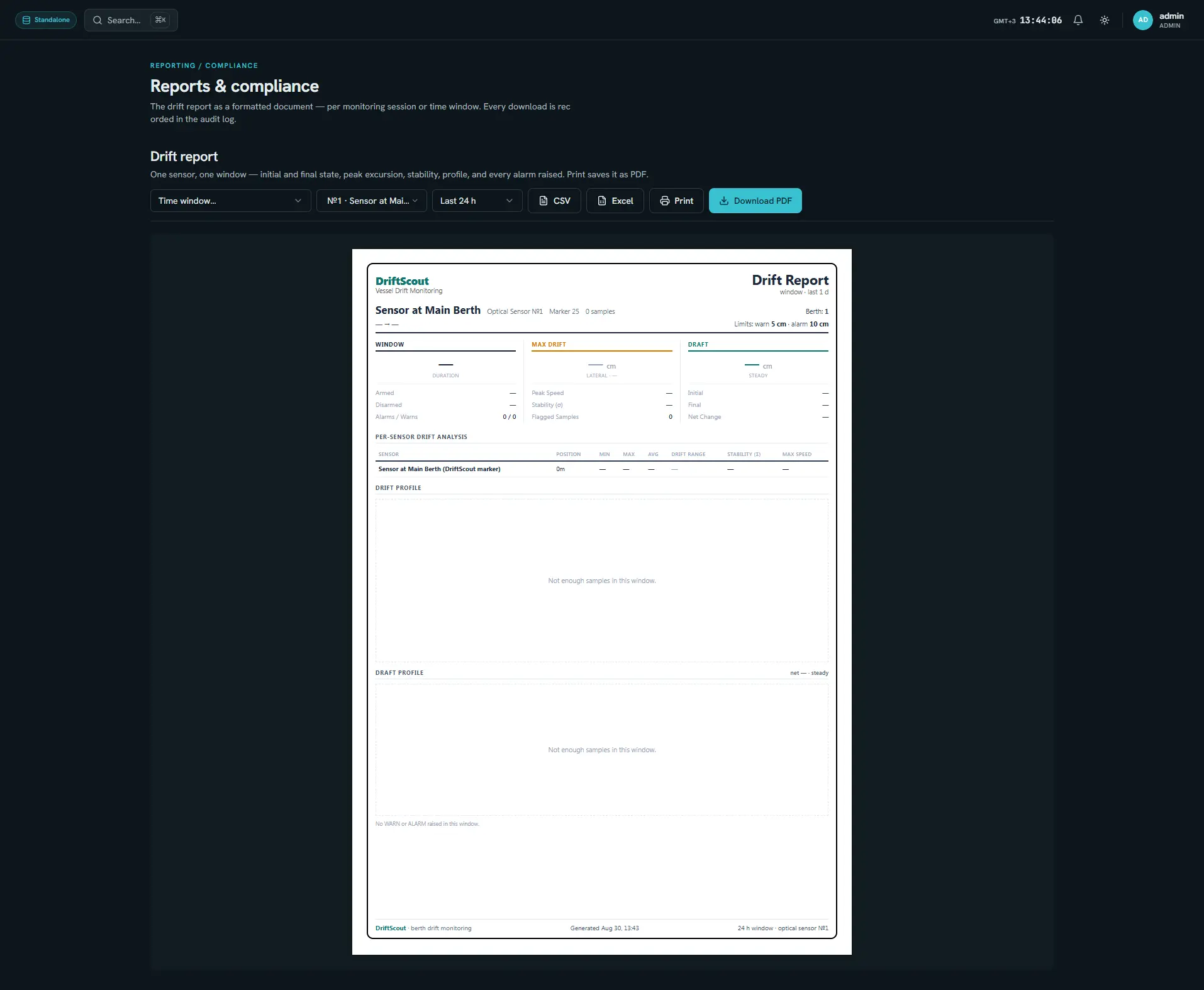
From the baseline onwards DriftScout keeps the measurements, the state changes, the alarms and who acknowledged them. Export it as CSV or PDF when an auditor asks.
CSV · PDF · Alarm history · Audit logA number the control room can act on during cargo transfer, and no extra work for ship’s staff.
Travel along the berth and rotation each carry their own WARN and ALARM thresholds per vessel class. Draft and standoff are reported and never alarm. Every alarm is stored with the reading that caused it and the name of whoever acknowledged it.
Wave motion filteredLens calibration runs once and the berth axis aligns itself. Lock it and neither a restart nor the API can overwrite it.
Locked once setModbus and OPC UA put every sensor in front of your PLC or DCS, with a direct alarm output and a heartbeat the watchdog can follow.
SCADA-readyProtocol emulators and scripted drills prove the integration before anyone wires a PLC.
No bench hardwareYou read the logs in the browser. DriftScout writes a backup on every boot.
No daily checksThe same measurement engine drives one sensor or twenty. Run it on its own, or inside your existing platform.
One sensor or twentyDriftScout publishes drift, alarm level and a heartbeat over Modbus and OPC UA. Both read the same values, so the control room and the terminal platform cannot show you different numbers.
Native TCP, RTU or serial. Live values and alert level, a direct alarm output, and a heartbeat your PLC can watch.
PLC / DCSEvery reading is a typed variable your control system can browse and subscribe to. No mapping table to maintain.
Browseable tagsFire beacons and IP speakers on an event. A REST API and a live WebSocket stream cover everything else.
REST / WebSocketStart at one berth on its own. Add sensors as other berths come online, and they share a single operating picture.
One berth, one box. Storage is built in, so there is no database to set up. DriftScout runs within a day.
Single berthReports into the terminal’s own platform, so the same berth history is visible where your operators already work.
Port-wideThese firm up during detailed engineering and the site acceptance test. We prove every installation by moving the target a known distance and checking what the console reads back.
Answered straight, including the parts that need a site survey.
It is built for an outdoor berth and it runs at night. Heavy fog and driving rain shorten the usable range, which is why we survey each berth first and write the working envelope into the acceptance test rather than quoting one figure for every site.
It bolts to fixed jetty structure, usually a gangway tower or a bollard column, and takes a standard industrial power feed. Your team picks the mounting point with us during scoping.
Terminal staff fit it once she is all fast and take it off before she sails, a couple of minutes either end, using the supplied pole. Nobody boards the vessel.
DriftScout sends a heartbeat alongside every measurement. If the heartbeat stops, the operator and the SCADA system both see it at once. A silent DriftScout always shows as a fault, never as a berth with nothing to report.
No, and that is deliberate. Draft is measured, reported and on the outputs, but it never alarms. The two alarm conditions are sustained travel along the berth and rotation, each with its own WARN and ALARM thresholds per vessel class.
Short-range 3D lidars from Navitrak, our berthing-aid system, measure the distance from hull to fender. Travel, draft and rotation all come from the hull target. See navitrak.io.
Yes. One installation covers a single berth, or several sensors work together across a port and share one operating picture.
Tell us about your terminal and we will come back with a monitoring layout and an accuracy figure for your berth.
Four lines is enough for a first pass.